The AI-Ready CFO Is Out October 5. It's Written for the Implementation Phase.
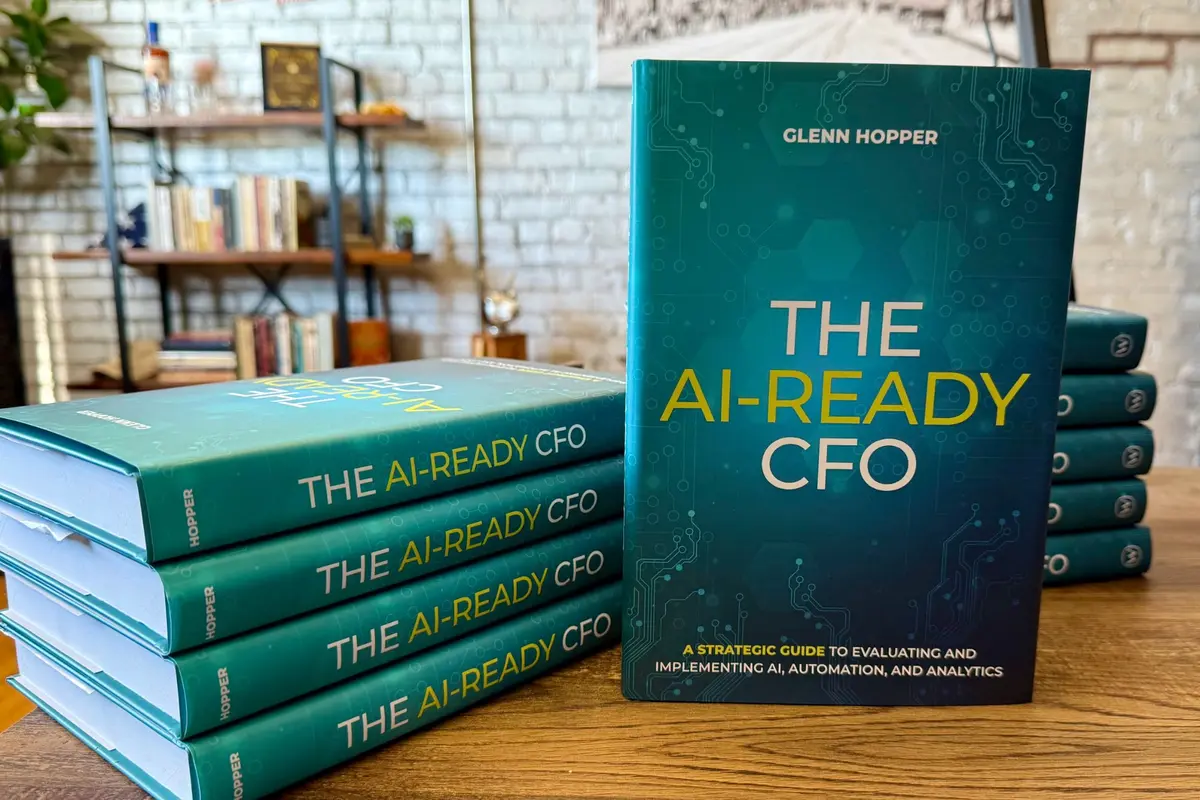
Gartner put a number on the finance AI stall last November. After jumping from 37% of finance functions using AI in 2023 to 58% in 2024, adoption barely moved in 2025, reaching 59%. And 91% of the 183 finance leaders in the survey reported low or moderate impact from what they'd deployed. The distance between buying AI and getting a return on it is the subject of The AI-Ready CFO: A Strategic Guide to Evaluating and Implementing AI, Automation, and Analytics, the third book from Glenn Hopper. Wiley publishes it on October 5, 2026.
Hopper's first two books built toward this one. Deep Finance: Corporate Finance in the Information Age (2021) made the case for data and machine learning inside the finance function. AI Mastery for Finance Professionals (2024) walked through the techniques, from machine learning to generative models, and how they apply to risk, fraud detection, compliance, and trading. The AI-Ready CFO starts where a finance leader lands after the pilot: the budget is approved, the board wants results, and the team has to run the new process at the next close. It's written for the CFO, controller, or FP&A lead who picks the vendor, redesigns the workflow, and signs the attestation.
The book is organized around four questions CFOs ask every day. How do I choose the right AI vendors and technologies? What's the best way to integrate generative AI into our financial workflows? How should I structure, train, and prepare my finance team for these changes? What governance frameworks, internal controls, and compliance considerations do I need to manage? Each answer draws on case studies from real implementations, including work at organizations like eBay, JPMorgan Chase, Microsoft, and Wells Fargo.
Vendor selection gets the most practical treatment. The book opens with what the technology does well and where it breaks, so a finance leader can sit across from a sales team and ask the right questions. Picture a demo where an agent matches invoices to purchase orders and clears 98% of them without a touch. The CFO's questions are about the other 2%: where the exceptions route, who approves an override, and what the audit trail shows when the external auditor pulls a sample in February. Hopper covers how to evaluate platforms against those questions, how to negotiate contract terms that tie the vendor to production results, and how to run a 90-day execution model that moves an initiative from pilot to production without stalling in committee.
The ROI chapters line up with what Gartner found in September. A survey of 160 senior finance leaders run from January through April showed that AP and AR automation, data extraction, and report creation typically pay back within nine to ten months, while forecasting, data management, and insight generation take longer. A separate Gartner survey in July found 45% of CFOs said their AI investments lean toward productivity, against 20% toward decision quality. The book measures return on accuracy gains, cycle-time compression, and audit-risk reduction alongside headcount, which gives a CFO a way to defend the longer-horizon forecasting project to the board before the savings reach the income statement.
The leadership half of the book covers the work that decides whether any of it sticks. Gartner's September research named low AI literacy as the most significant barrier finance leaders now face. Hopper addresses how to reorganize a finance team when routine reconciliations move to software, how to train analysts to review and validate agent output, and how to manage the change when roles shift mid-year. On governance, he lays out data governance, model validation, explainability, and control design built around SOX, GAAP, and IFRS, along with a function-by-function tool map spanning FP&A, treasury, tax, internal audit, and controllership.
Hopper has served as CFO for multiple companies and founded RoboCFO, a consulting firm focused on AI in finance, where he leads AI research and solution development for finance and accounting teams. He teaches AI and finance courses through Duke University's Fuqua School of Business, the Corporate Finance Institute, the AICPA, and LinkedIn Learning, and serves on advisory boards for Preql, the Crews School of Accountancy at the University of Memphis, GENCFO USA, and the AI Leaders Council. He holds a master's degree in finance and a graduate certificate in business analytics from Harvard University, and an MBA from Regis University. His commentary has appeared in Forbes, Fortune, and The New York Times.
The timing fits the calendar most finance teams are on. The 2027 budget is being built right now, and AI line items are in it at most companies. Those line items will be judged next year on production results, and the teams that pick vendors carefully, train their people, and build the controls first are the ones that will have those results to show. The AI-Ready CFO is available in hardcover from Wiley, Amazon, and Barnes & Noble. More on the book is at robocfo.ai/ai-ready-cfo.
 Ask SAL