Knowledge Base
Frequently Asked Questions
Everything you need to know about AI in corporate finance, Glenn Hopper's services, and how to get started.

Getting Started with AI in Finance
What does AI in corporate finance actually look like day-to-day?+
It depends on the function, but the through-line is removing manual, repetitive work so finance teams can focus on analysis and strategy. In accounts payable, that might mean intelligent invoice matching that flags anomalies instead of making someone eyeball every line. In FP&A, it could be a forecasting model that pulls actuals automatically, detects trends in revenue drivers, and produces a rolling forecast without the usual spreadsheet gymnastics. Treasury teams use ML for cash-flow prediction. Controllers use NLP to scan contracts for revenue recognition triggers. The common thread: AI handles the data wrangling and pattern recognition, and your people handle the judgment calls.
Where should a finance team start with AI?+
Start with a process that is painful, repetitive, and data-rich. Month-end close tasks, variance analysis, expense categorization, and cash-flow forecasting are all strong candidates. The goal is to pick something where the ROI is obvious and the risk is low, so you can build confidence and momentum before tackling bigger strategic initiatives. Glenn typically recommends a 90-day pilot focused on one workflow.
Do I need a data science team to use AI in finance?+
No. A lot of modern AI tooling is designed for business users, with no-code or low-code interfaces. That said, you do need someone who understands both the finance workflows and the data. Glenn’s approach bridges that gap: he helps finance leaders evaluate tools, clean up data pipelines, and implement solutions without requiring a dedicated ML engineering team. For more complex use cases like custom predictive models, he can bring in specialized resources.
How is AI in finance different from traditional automation or RPA?+
RPA follows rigid rules: “if this cell equals X, copy it to column Y.” It breaks when the format changes. AI and machine learning work differently. They learn patterns from data, handle variability, and improve over time. RPA is great for structured, predictable tasks. AI excels where data is messy, volumes are high, or the process requires judgment-like decisions such as anomaly detection, natural-language processing of contracts, or dynamic forecasting. In practice, the best implementations layer AI on top of RPA to get the benefits of both.
Services & Finance Automation
What consulting services does Glenn Hopper offer?+
Glenn works with CFOs, controllers, and FP&A leaders to implement AI across their finance functions. That includes AI readiness assessments, tool evaluation and selection, data strategy and pipeline design, pilot program design and execution, and ongoing advisory for scaling AI post-pilot. Engagements range from a focused half-day workshop to multi-month transformation programs. Details are on the Services page.
What industries does Glenn work with?+
Glenn has worked across a range of industries including technology, financial services, healthcare, manufacturing, professional services, and private equity portfolio companies. The common thread is finance teams with meaningful data volume who want to move from reactive reporting to predictive, AI-augmented decision-making.
Can AI really improve our month-end close?+
Yes, and it is one of the highest-impact starting points. AI can automate journal entry preparation, flag reconciliation exceptions, detect anomalies in trial balance data, and surface issues that would normally take days of manual review. Teams Glenn has worked with have cut close timelines by 30 to 50 percent while actually improving accuracy. The key is structuring the data inputs correctly so the models have clean signals to work from.
How does AI-powered FP&A forecasting compare to spreadsheet models?+
Spreadsheet models are deterministic: they produce one answer based on fixed assumptions. AI-powered forecasting is probabilistic. It can weight hundreds of variables, detect non-linear relationships, and produce range-based forecasts with confidence intervals. The practical result is forecasts that adapt to changing conditions faster and surface risks your spreadsheet would miss. Glenn helps teams transition from static Excel models to dynamic ML-powered forecasting without losing the transparency finance leaders need.
What is an AI readiness assessment?+
It is a structured evaluation of where your finance organization stands relative to AI adoption. Glenn examines your data infrastructure, process maturity, team capabilities, and technology stack. The output is a prioritized roadmap that identifies quick wins, longer-term strategic plays, and the gaps you need to close (data quality, tooling, skills) before AI can deliver real value. It typically takes two to three weeks and results in a concrete action plan.
How long does a typical AI implementation take in finance?+
A focused pilot on one process (say, cash-flow forecasting or automated variance analysis) can go from kickoff to production in 8 to 12 weeks. Broader transformation programs that touch multiple functions typically run 6 to 12 months. The timeline depends on data readiness, organizational buy-in, and complexity. Glenn structures engagements to deliver measurable value within the first 90 days, regardless of the overall program length.
What tools and platforms does Glenn recommend for finance AI?+
There is no single right answer because it depends on your existing stack, data volume, and use case. Glenn works across a range of platforms and stays vendor-neutral. He evaluates tools based on integration capabilities, total cost of ownership, ease of adoption, and fit with your specific finance workflows rather than pushing any one product. For a detailed breakdown of seven AI-native ERP platforms rebuilding finance from the ground up, see the AI-Native ERP Landscape.
How do you handle data security and compliance in AI implementations?+
Data governance is built into the process from day one. Glenn works within existing security frameworks and helps teams establish AI-specific policies covering data access controls, model explainability requirements, audit trails, and regulatory compliance (SOX, GDPR, industry-specific requirements). Finance data is sensitive by nature, and any AI implementation that does not address security head-on is a liability.
Strategy, ROI & Decision-Making
What kind of ROI can we expect from AI in finance?+
ROI varies by use case, but the patterns are consistent. Process automation (invoice processing, reconciliation) typically delivers 40 to 60 percent time savings. Predictive analytics (forecasting, cash management) often improves accuracy by 20 to 35 percent. Risk and anomaly detection can catch issues worth multiples of the implementation cost. Glenn helps clients build a business case with realistic projections before any investment is made.
How should a CFO think about the build-vs-buy decision for AI?+
Most finance teams should buy (or subscribe to) purpose-built tools for common use cases like forecasting, anomaly detection, and process automation. Building custom models makes sense when you have a genuinely unique data asset or process that off-the-shelf tools cannot handle. The trap is overbuilding. Glenn has seen companies spend millions on custom platforms when a well-configured SaaS tool would have delivered 90 percent of the value in a fraction of the time.
How do we measure the success of an AI initiative in finance?+
Define metrics before you start, tied to the specific problem you are solving. For process automation: time saved, error rates, throughput. For forecasting: accuracy improvement vs. prior method (MAPE, bias reduction). For anomaly detection: catch rate, false positive rate, dollar value of issues identified. Glenn works with clients to set baselines and track outcomes so the business case is always grounded in real numbers.
What are the biggest risks of AI adoption in finance?+
The top risks are poor data quality feeding bad models, lack of organizational buy-in leading to shelfware, over-reliance on AI outputs without human validation, and regulatory or compliance blind spots. None of these are reasons to avoid AI. They are reasons to approach it with a structured methodology. Glenn’s engagements are specifically designed to mitigate each of these risks through proper scoping, governance, and change management.
Will AI replace finance professionals?+
No, but it will reshape what finance professionals spend their time on. The transactional, data-gathering, and reconciliation work that consumes 60 to 70 percent of most finance teams' time is exactly what AI automates well. That frees people to do more analysis, business partnering, and strategic work. The finance professionals who learn to work alongside AI will be significantly more valuable. The ones who refuse to adapt will find their roles shrinking.
How do you get organizational buy-in for AI in finance?+
Start with a quick win that produces visible results. Nothing sells AI internally like a pilot that cuts a painful process in half. From there, quantify the results and present them in language the C-suite cares about: cost reduction, speed, accuracy, risk mitigation. Glenn often facilitates executive workshops to align leadership on AI strategy and build a shared understanding of what is realistic vs. aspirational.
What does an AI-augmented finance team structure look like?+
The org chart does not necessarily change, but roles evolve. Analysts shift from data gathering to data interpretation. FP&A moves from building spreadsheets to tuning models and challenging outputs. Controllers focus on exception handling and judgment calls rather than tick-and-tie work. Some teams create a dedicated “Finance AI” function or center of excellence. Others embed AI capabilities within existing teams. Glenn helps design the structure that fits your organization.
Books & Publications
What is The AI-Ready CFO about?+
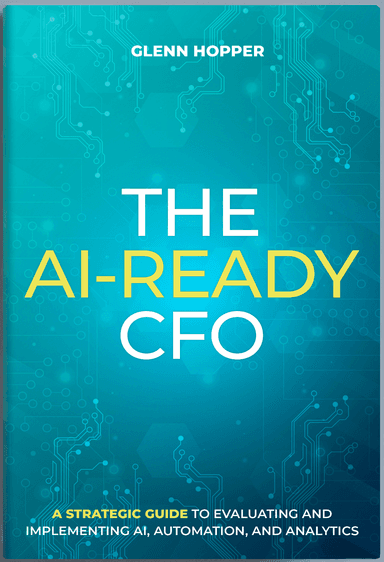
The AI-Ready CFO is Glenn’s forthcoming book from Wiley, publishing September 29, 2026 (ISBN: 978-1-394-41588-5). It is a practical guide for finance leaders who want to implement AI in their organizations. The book covers everything from building a business case for AI to selecting the right tools, managing change, and measuring outcomes. It is written for CFOs, controllers, VP Finance, and FP&A leaders who need actionable frameworks rather than theoretical overviews. Pre-order links are on the book page.
How is The AI-Ready CFO different from other AI business books?+
Most AI books are written by technologists for technologists, or they stay at 30,000 feet with generalities about digital transformation. The AI-Ready CFO is written by a sitting CFO for other finance leaders. Every chapter is grounded in real finance workflows: forecasting, close, treasury, audit, FP&A. Glenn draws on his own experience implementing AI in finance roles, plus case studies from his consulting work. It is specific, practical, and honest about what works and what does not.
The AI-Ready CFO
Coming September 29, 2026 from Wiley. The practical playbook for finance leaders ready to implement AI.
Training & Education
What training programs does Glenn offer?+
Glenn offers workshops and training programs designed for finance professionals at every level. Formats range from half-day executive briefings to multi-day hands-on workshops. Topics include AI foundations for finance, prompt engineering for financial analysis, building AI-powered dashboards, and strategic AI roadmapping. Custom programs can be designed for specific teams or organizations. See the Learn page for current offerings.
Are the workshops hands-on or lecture-based?+
Both, but weighted toward hands-on. Glenn typically opens with conceptual framing (30 minutes or so), then moves into guided exercises where participants work with real tools and real data. The goal is for attendees to leave with skills they can apply immediately, not just slides to file away.
Do you offer training for teams or just individuals?+
Both. Public workshops are open to individual registrants. Private engagements are designed for intact teams, often customized around the organization’s specific tech stack, data, and processes. Team training tends to be more effective because everyone builds a shared vocabulary and can support each other post-workshop.
Speaking & Events
What does Glenn speak about?+
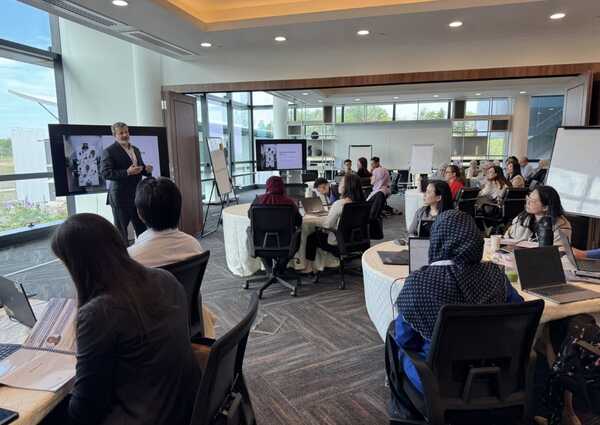
Glenn’s keynotes and presentations cover AI in corporate finance, the future of the CFO role, building AI-ready finance teams, and practical strategies for technology adoption. He tailors every talk to the audience, whether that is a room full of CFOs at a national conference or an internal leadership team exploring AI for the first time. See past events and topics on the Speaking page.
How do I book Glenn for a speaking engagement?+
Use the Contact page or reach out directly via email. Include the event name, date, audience size and type, and any specific topics you would like covered. Glenn speaks at conferences, corporate events, board retreats, and industry association meetings.
Can Glenn speak on a podcast or webinar?+
Absolutely. Glenn regularly appears as a guest on finance, technology, and AI podcasts. If you are a podcast host or webinar organizer, visit the Podcast Guest page for Glenn’s bio, headshot, and suggested topics, or reach out via the Contact page.
About Glenn Hopper
What is Glenn Hopper's background?+
Glenn Hopper is a CFO, author, speaker, and one of the leading voices on AI in corporate finance. He has spent over two decades in finance leadership roles and has been implementing AI and machine learning in finance operations since well before it was mainstream. He is the author of Deep Finance and the forthcoming The AI-Ready CFO (Wiley, September 2026). He serves on advisory boards, speaks at major conferences, and consults with finance teams worldwide on AI strategy and implementation.
What is RoboCFO.ai?+
RoboCFO.ai is Glenn Hopper’s platform for AI-in-finance consulting, speaking, training, and content. It is the hub for his advisory services, workshop offerings, newsletters, podcast, and books. The name reflects the vision: helping CFOs and finance leaders harness AI to become more effective, more strategic, and more future-ready.

Glenn Hopper
CFO · Author · AI Finance Strategist
Two decades of finance leadership. Pioneer in applying AI and machine learning to corporate finance. Author of Deep Finance and The AI-Ready CFO.
Still have questions?
Glenn is happy to talk through your specific situation.
 Ask SAL