AI and the Month-End Close. It's Closer Than Your Team Thinks.
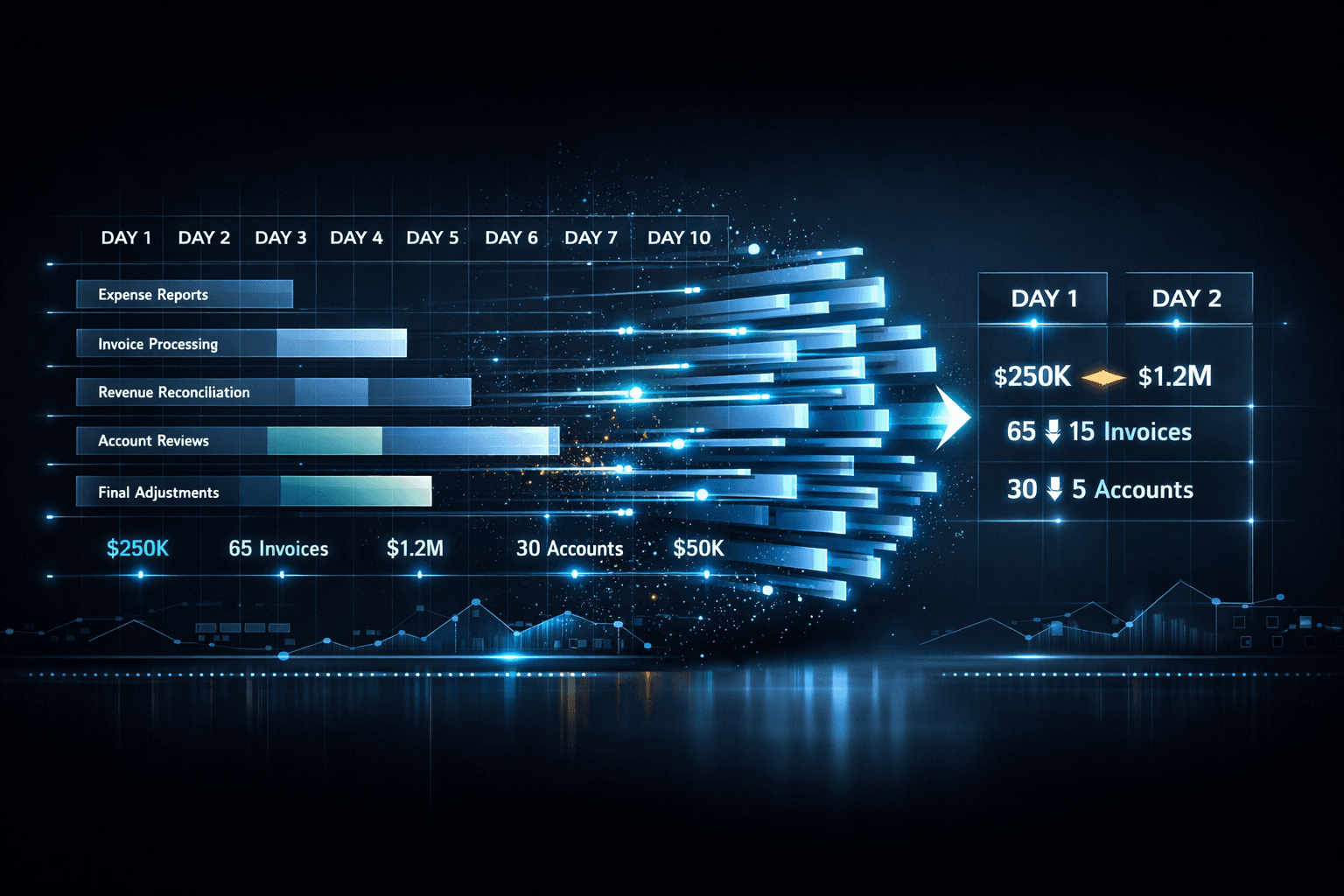
Gartner's latest CFO survey puts the median month-end close at eight business days. That number has barely moved in a decade. Meanwhile, the tools that finance teams already license (BlackLine, FloQast, Oracle, SAP) have shipped AI capabilities that most organizations haven't turned on yet. An AI readiness assessment can reveal whether your team is positioned to activate them. The gap between what's possible and what's happening in practice is wide, and it's worth understanding exactly where the leverage sits.
Start with reconciliations, because that's where the hours pile up. A mid-market company running 200-400 account reconciliations per close cycle can automate roughly 60-70% of them with today's matching algorithms. The AI flags exceptions, a human reviews the flags, and the rest auto-certify. BlackLine reports that customers using its AI-assisted matching see reconciliation time drop by about 50%. FloQast's flux analysis tools generate variance narratives automatically, pulling actuals-to-budget comparisons and drafting the first pass of commentary that used to take analysts hours to write by hand.
Journal entries are the second big target. Recurring entries, accruals, reclassifications: these follow patterns that machine learning models handle well. The trick is that you need clean historical data to train on, and many organizations don't have it. These are among the most impactful AI use cases in FP&A, but only when the data foundation is solid. If your team has been keying entries manually into spreadsheets before uploading to the ERP, there's a data cleanup phase before automation pays off. That's a real constraint, and it's one that vendors tend to gloss over in demos.
The piece that gets less attention is task orchestration. A 10-day close isn't slow because every individual task takes too long. It's slow because tasks run sequentially when they could run in parallel, because dependencies aren't tracked well, and because nobody knows which tasks are actually blocking the critical path. AI-driven close management platforms model these dependencies explicitly. They assign tasks based on who's available, send reminders based on actual completion risk, and surface bottlenecks before they cascade. The real value is automating the project management layer around the close, the sequencing and tracking that determines whether your team finishes in 3 days or 10.
So what does a realistic compressed close look like? For a company in the $500M-$2B revenue range, cutting from 8 days to 3-4 days is achievable within 6-9 months if you sequence the work correctly. The crawl-walk-run approach applies here: start with auto-reconciliation of your highest-volume, lowest-risk accounts (bank recs, prepaid amortization), then layer in journal entry automation, then tackle orchestration. Trying to do all three simultaneously is how these projects stall out. Each phase builds the data quality and team confidence that the next phase depends on.
The "continuous close" concept that vendors pitch (closing the books in real time, every day) remains aspirational for most organizations. It requires a level of system integration and data maturity that few companies outside the Fortune 100 have achieved. But you don't need a continuous close to see material improvement. Compressing from 8 days to 3 means your leadership team gets financial data a full business week earlier. That's a week of better decision-making per month. Over a fiscal year, that compounds into something significant.
The audit angle matters too. AI-assisted closes produce better documentation by default, because every automated step generates a log. Reconciliation sign-offs, journal entry approvals, task completions: they all carry timestamps and user attribution. When external auditors arrive, the close package is already built. Teams that have implemented AI-driven workflows in their close process consistently report that audit prep time drops by 30-40%, which is a second-order benefit that doesn't show up in the initial ROI model but quietly pays for the whole initiative.
Quantifying the payback from close compression is straightforward with the right model; the AI ROI Calculator can help build that case. The window for early-mover advantage here is narrowing. As these capabilities become standard features in every major close management platform, the differentiator shifts from "do you use AI in your close?" to "how well have you tuned it to your specific workflows?" Finance leaders who start now are building institutional knowledge that takes quarters to develop. The technology is ready. The question is whether your close process is ready for the technology.
 Ask SAL