AI Agents Are Doing the Work Now. What Opus 4.6 and GPT-5.4 Mean for the Finance Function.
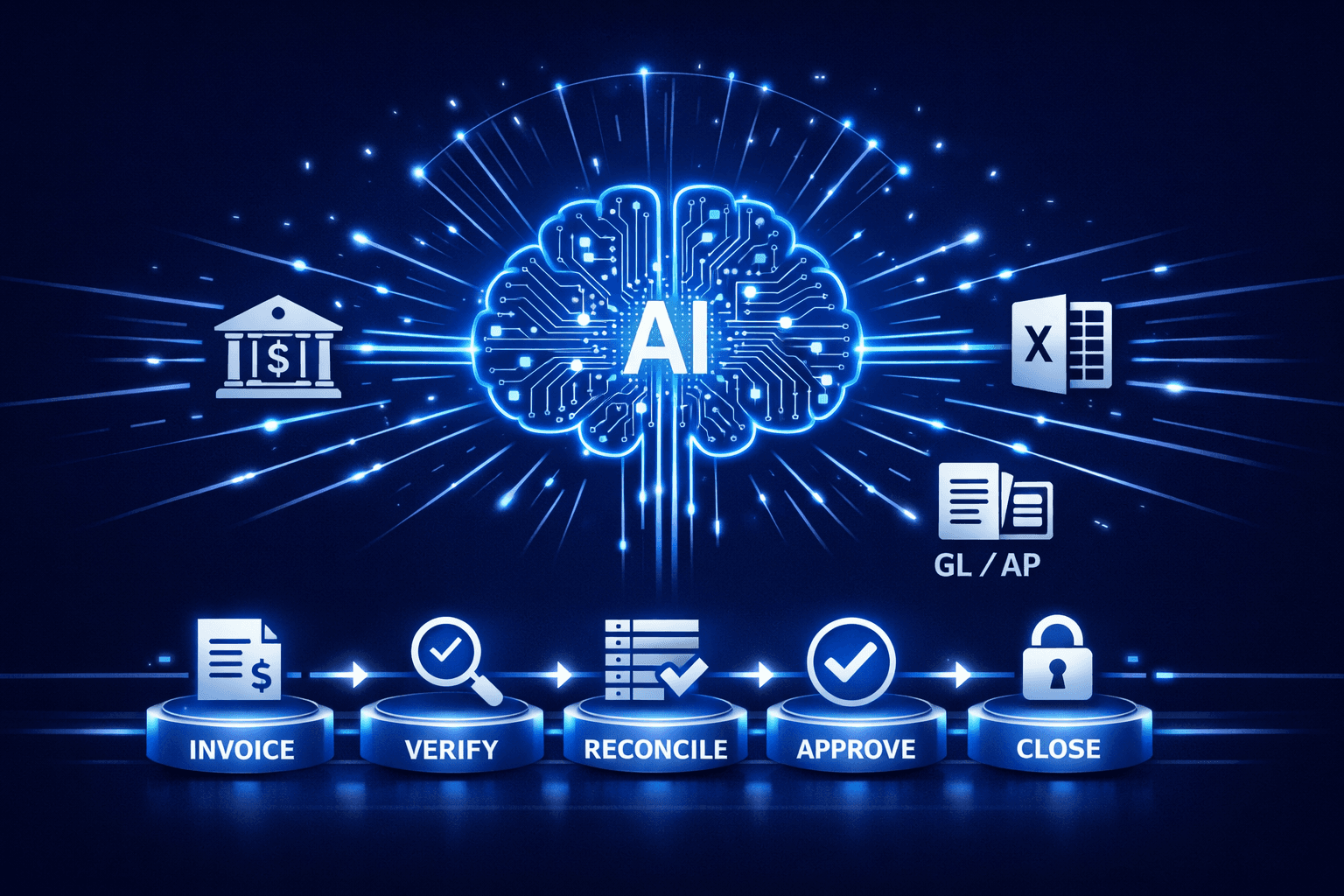
When OpenAI shipped GPT-5.4 on March 5th, the most revealing part of the announcement was a demo: the model pulled three tax source documents into an Excel workpaper template, verified twelve QuickBooks Online files for broken bank feeds, then scheduled itself to rerun the same receipts-to-transaction workflow every night. No human in the loop for any of it. That's a different category of capability than what finance teams were working with even twelve months ago.
The preceding two years of AI in finance were largely about reading. Models summarized board decks, drafted variance commentary, and helped analysts write up close packages faster. Useful, but still essentially an improved research assistant. What's shifted in early 2026 is execution. Claude Opus 4.6, which Anthropic released in February, ships with a 1 million token context window and a Compaction API that compresses earlier conversation state as memory fills. That architecture change matters operationally: an agent running a full AP automation cycle can check an invoice against vendor records, verify payment terms, route for approval, and log the result without losing context from three hours earlier in the same workflow. Opus 4.6 also ships with Agent Teams, letting developers spin up multiple coordinated agents that divide complex tasks and run them in parallel.
GPT-5.4 has comparable range. OpenAI built the model to navigate desktops, browsers, and software autonomously, and launched it with direct integrations for FactSet, MSCI, Third Bridge, and Moody's. Investment teams can now pull market data, internal research, and valuation models into a single agentic workflow without writing any integration code. For accounting teams, the model demonstrated completing a full reconciliation and scheduling its own follow-up. The bottleneck in finance automation has shifted: it's no longer model capability. It's knowing which workflows to hand off first.
The infrastructure enabling this is the Model Context Protocol, an open standard Anthropic introduced in late 2024 that OpenAI formally adopted in March 2025. MCP standardizes how AI agents connect to external systems, replacing one-off custom integrations with a single protocol spanning ERPs, GL systems, AP platforms, data warehouses, and document storage. Oracle announced the NetSuite AI Connector Service on August 12, 2025, part of a broader shift in the AI-native ERP landscape, which exposes NetSuite's data and business logic to any MCP-compatible AI client, whether that's Claude, GPT-5.4, or an in-house model. The connector uses permission-scoped sessions rather than long-lived API credentials, so the agent gets enough access to do useful work without touching the rest of the ERP. NetSuite's 2026.1 release has already added AI-predicted payment dates on invoices, using historical transaction data to forecast when a customer will actually pay. Independent estimates put time savings from automating routine NetSuite queries via AI at ten to twenty hours per finance analyst per week.
The broader connector ecosystem has scaled quickly. Tens of thousands of MCP servers are now available on mcp.so, covering AP platforms, market data providers, payroll systems, and more. Plugins and connectors bundled for specific environments, like the integrations available in Cowork and Claude Code, let finance teams wire up Bill.com, their bank feed, and their GL in minutes and have an agent reconcile, flag exceptions, and route approvals without writing custom code. Basis, the AI accounting platform that raised $100 million in 2025, completed what it described as the first fully autonomous end-to-end 1065 tax return. That task typically takes a junior accountant or offshore team ten to fifteen hours of manual extraction and tie-out work. CPA firms using Basis report 30 to 50 percent efficiency gains on similar processes.
CFOs are paying attention, but they're moving carefully. A Journal of Accountancy survey from February 2026 found that 96 percent of finance chiefs rated human oversight of agentic AI as critical to accuracy. HPE CFO Marie Myers identified accounts receivable processing and forecasting as her top two AI agent priorities for 2026. The governance posture emerging across the function shifts the human role from execution to review: the controller validates the exception report the agent flags, not every transaction; the AP team approves the payment batch the agent assembled, not each invoice. That restructuring changes what finance headcount actually does during the week, and it requires rethinking what meaningful review looks like at scale. A clear implementation playbook helps CFOs sequence governance ahead of deployment.
Security will determine how fast this moves. Early MCP deployments exposed prompt injection vulnerabilities and tool-permission gaps that researchers flagged in April 2025. Implementations that hold up are using OAuth 2.1 authentication, role-based access controls, and version pinning. Treat AI agent access like privileged user access: scoped tightly, logged completely, reviewed on a schedule. An AI governance policy formalizes those access controls. Gartner projects that by 2028, 33 percent of enterprise software will include agentic capabilities, up from under 1 percent today. Every quarter, the models sustain longer workflows, the MCP ecosystem adds connectors, and the scope of what agents handle in finance expands from transactional to analytical. Month-end close that routes itself. Variance analysis that escalates when a number looks wrong. Forecasts that flag their own broken assumptions. The work is being restructured around a different kind of human judgment, and the restructuring is moving faster than most finance roadmaps anticipated.
 Ask SAL