The Core Test
Every MGP answers three questions
Does this use case create measurable value?
Can it operate safely within our controls?
Is it repeatable across other workflows?
When a pilot answers all three with a "yes," it establishes a pattern. That pattern becomes scale. When the answer is "no," the pilot gets refined or retired before it consumes more resources.
Structure
Five linked components
Every MGP follows the same architecture. The components link together so that each cycle carries forward lessons in tool selection, governance, ROI measurement, and agile delivery.
Readiness
Data access, process owners, and success metrics confirmed before work begins. No pilot should launch until the team has agreed on what success looks like and where the data lives.
Thin Slice Delivery
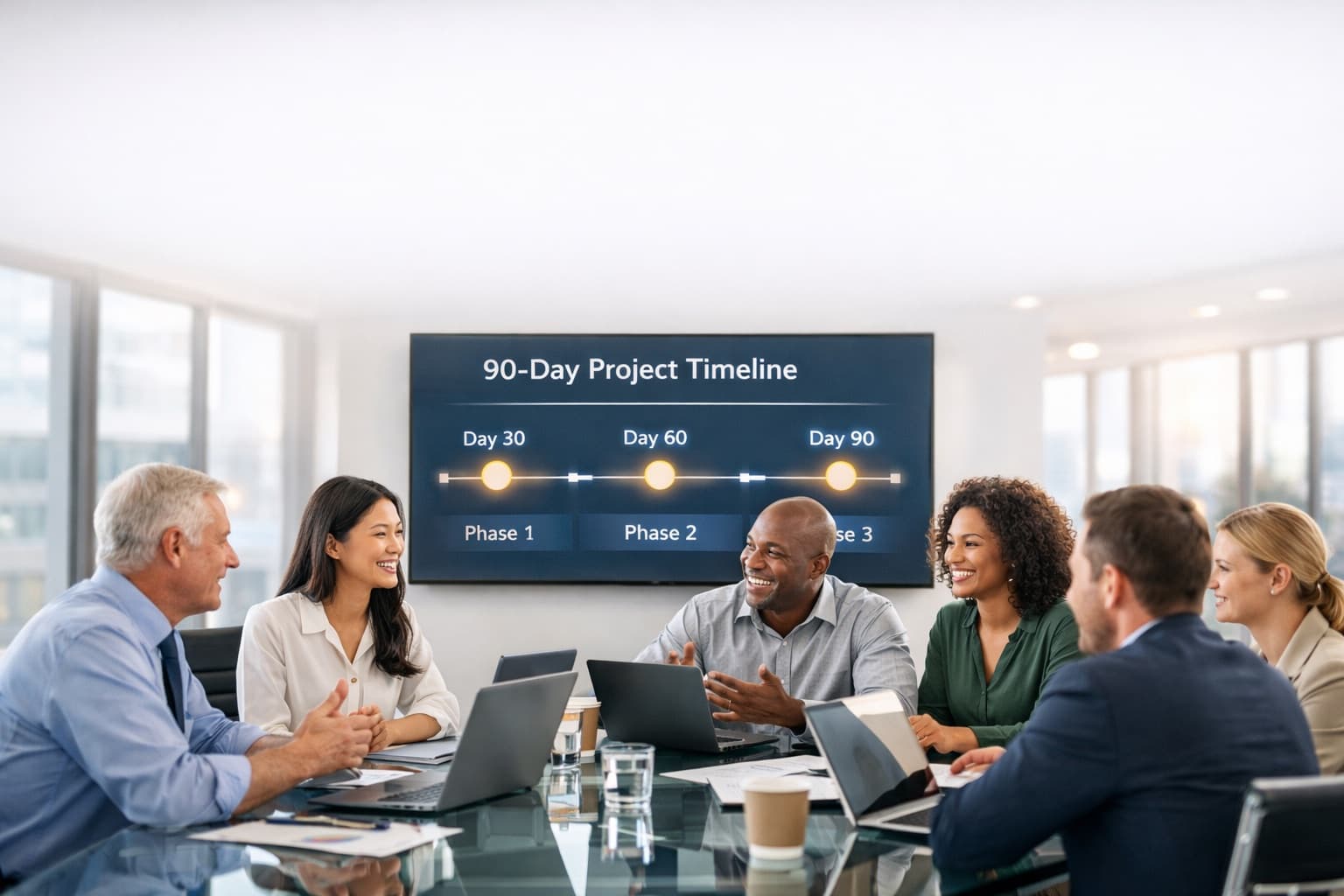
A small but functional piece of the workflow that can run in production conditions within 90 days. The goal is a working slice, not a prototype buried in a sandbox.
Evaluation
Accuracy, latency, and cost tracked against the baseline ROI agreed at launch. Evaluation begins during the cycle, not at the end. If AI saves the team time, they become advocates. If it doesn't, you find out before the budget is spent.
Evidence
Prompts versioned, outputs logged, human reviews captured, and all artifacts consolidated in an evidence pack. Every MGP leaves behind a documented trail that satisfies the auditor's questions in a single file.
Decision Gate
Scale, refine, or retire based on verified results. This gate is binary by design. A pilot that answers 'yes' to value, safety, and repeatability earns the right to expand. Everything else gets refined or shut down.
Why "Minimum Governance"
The discipline behind the name
"Minimum governance" doesn't mean minimal control. It means no unnecessary control. The framework inserts the least structure required to produce credible evidence. That discipline is what makes scaling possible.
It prevents the sprawl of unverified tools while keeping innovation alive. Each MGP leaves a documented trail that lets finance move quickly while still answering the auditor's questions. If an idea is worth testing, it deserves an MGP. If it can't meet MGP standards, it's not ready for finance.
From Pilot to Scale
How MGPs connect strategy to scale
The CFO's roadmap consists of many MGPs linked in sequence. Each completed cycle leaves behind validated prompts, performance metrics, evidence packs, and refined governance practices.
Phase 1
Proof
One or two MGPs focused on quick-win use cases: variance commentary, duplicate-invoice detection, or reconciliations. These establish proof and credibility.
Phase 2
Momentum
Copy with variation. Replicate successful MGPs across adjacent processes to build organizational muscle and demonstrate that the pattern works beyond a single team.
Phase 3
Scale
Wave planning. Combine multiple MGPs into broader programs such as forecasting acceleration or close optimization. The evidence from earlier phases makes this defensible.
ROI in Every Cycle
Because finance lives by numbers
Every MGP begins with a quantified hypothesis of value. At the end of the cycle, metrics are compared to baseline. Even small improvements create a cumulative return when repeated across dozens of workflows.
Efficiency ROI
Hours saved, error rates reduced, throughput increased
Effectiveness ROI
Faster insight generation, improved forecast accuracy
Control ROI
Reduction in manual checks or audit exceptions
Get Started
Ready to run your first MGP?
We help finance teams design, execute, and scale their first 90-day AI pilots with the governance rigor the CFO's office demands.
 Ask SAL