What You'll Learn in This Guide
This guide covers the practical steps CFOs should take to implement generative AI in their organizations: how to assess readiness, where to start, how to evaluate vendors, how to govern the technology inside a control environment, and how to scale from a single pilot to an enterprise capability. It draws on frameworks from The AI-Ready CFO (Wiley Finance, September 2026), including the Minimum-Governance Pilot, the AI Readiness Checklist, and the AI Risk Register.
The CFO's Role in Generative AI
Generative AI has arrived inside finance whether the CFO sanctioned it or not. Multiple industry surveys have confirmed widespread unauthorized AI use in the workplace. Ban ChatGPT, and someone on your team will still copy sensitive data into a personal account, use a free consumer version with weaker security, or turn to an unvetted AI tool you've never heard of. The risk doesn't disappear. It moves underground where you can't monitor usage, audit conversations, or enforce data policies.
That reality makes the CFO the natural owner of this transition. The role already sits at the intersection of data governance, capital allocation, risk management, and operational accountability. Generative AI touches all four. If the CFO doesn't lead the adoption, the center of gravity shifts to whichever team moves fastest and starts answering leadership questions first.
Leading the adoption means three things. First, evaluating and selecting tools with the same rigor applied to ERP selection. Second, establishing governance that satisfies auditors and regulators without choking off experimentation. Third, using AI to move finance toward faster, more continuous decision support. When the CFO owns that translation layer between technology teams, vendors, and business units, finance becomes a driver of strategy. When it's left to chance, finance falls behind.
Understanding What Generative AI Actually Does
Finance leaders don't need an engineering-level explanation of large language models. They need a working model of what the tools do, where they fit in finance workflows, and where they fail if controls aren't in place.
At its core, an LLM is a prediction engine. You give it an input (a prompt), and it generates an output one token at a time based on probabilities learned during training. The model doesn't "know" anything in the way a human does. It generates language based on statistical patterns, which means it can produce shallow or misleading narratives unless the output is grounded in enterprise systems and supporting evidence.
This matters because it shapes how CFOs should deploy these tools. Generative AI is powerful where language is the bottleneck: drafting variance explanations, summarizing board packages, outlining investor updates, generating scenario narratives. Human review remains the control point. The technology accelerates the first draft. The finance team validates accuracy, adds judgment, and ensures the output ties out to the numbers.
Three categories of generative AI tools show up in finance today:
Chatbots answer questions, retrieve information, and summarize reports. They require humans to act on the output. Wells Fargo, for example, has tested generative AI systems that read and summarize analyst reports for finance teams, saving hours of manual review.
Copilots are embedded assistants that draft, explain, and suggest. Microsoft Copilot for Finance generates variance explanations in Excel, reconciles data with SAP or Dynamics 365, and drafts collection summaries in Outlook. The tool reduces manual effort and shortens reporting cycles, but requires human sign-off consistent with Sarbanes-Oxley controls.
Agents execute multi-step workflows across tools and data sources. They can plan, use applications, and pursue a goal without constant human prompts. Early pilots at firms like Deloitte have explored agents that reconcile accounts by connecting to ERP systems, flagging mismatches, preparing draft entries, and routing them to reviewers. Agents raise the bar for auditability, logging, and control design.
The distinction matters for governance. A chatbot that summarizes a document carries different risk than an agent that executes journal entries across systems. CFOs should evaluate tools based on what they actually do, where they touch data, and what controls are required.
Assessing Readiness: The Eight-Dimension Checklist
Before launching any pilot, CFOs should evaluate readiness across eight dimensions. The answers won't always be binary, but the process of asking the questions reveals where the foundation is solid and where more groundwork is required.
Data Foundation. Is financial and operational data clean, structured, and consistently formatted? Are historical records complete enough to train or benchmark models? AI amplifies whatever it finds. Clean data produces useful outputs. Messy data produces confident-sounding errors.
People. Does the team have the skills to evaluate AI outputs? Have training needs been identified for analysts, managers, and executives? Are incentives aligned so adoption improves career growth rather than threatening it?
Technology. Does the existing infrastructure (ERP, data warehouse, APIs) support AI integration? Can the IT team support the deployment model, whether cloud, hybrid, or behind the firewall?
Strategy. Has the CFO defined which use cases to pursue first and why? Is there a clear connection between the AI initiative and a measurable business outcome?
Change Management. Is there a plan for communicating the "why" to the organization? Have potential champions been identified, practitioners who will use the tools daily and build trust through visible results?
Cost Discipline. Has a business case been built that ties spend to measurable outcomes? Is there a threshold where, if ROI doesn't materialize, the project pauses or stops? Large models carry real compute and licensing costs that can climb quickly if usage isn't tracked.
Regulatory Awareness. Are emerging frameworks like the EU AI Act and SEC disclosure expectations understood? Has the team mapped how AI adoption intersects with SOX and ICFR controls?
Vendor Transparency. Does the team know which underlying model powers each tool? Has the vendor disclosed training data sources, update cadence, governance features, and audit log capabilities?
Scoring each question on a one-to-five scale creates a readiness index that can be compared across candidate projects. Scores below three in Data, Strategy, or Regulatory Awareness signal the organization isn't ready. Scores below three in Change Management or People indicate high risk of failed adoption even if the technology works.
Addressing the Security Concern
The CISO's instinct with new enterprise technology is to lock it out. With generative AI, the fear is that models will "remember everything," leak confidential prompts, or expose sensitive data across teams. These fears have led to blanket usage bans in some finance organizations.
Here's what the enterprise-grade tools actually provide. The leading LLMs (OpenAI, Anthropic's Claude, Google's Gemini, Microsoft Copilot) are SOC 2 Type II compliant. They offer encryption at rest and in transit, strict tenant isolation, and customizable data retention policies. They log access, enforce admin roles, and adhere to data residency requirements.
Much of the concern stems from a misunderstanding of how LLMs process information. Three types of data interaction get confused. Session context is temporary; the model holds your prompt only long enough to generate a response. Chat history or memory is optional and managed at the user or admin level. Model training data shapes the model during development, and enterprise providers explicitly exclude customer inputs from that process. The AI doesn't "learn" from your data unless the organization grants permission.
The productive path is controlled adoption: SSO, audit logs, access limits, and data retention policies. Finance teams using enterprise-grade environments are drafting board materials, identifying forecast anomalies, and processing documents, all within governed platforms. The risk of doing nothing, of pushing AI use underground into unmonitored consumer tools, is greater than the risk of deploying it with proper guardrails.
Starting with the Right Use Cases
The first generative AI implementation should be visible, low-risk, and fast to demonstrate value. Five use cases consistently meet those criteria for finance teams:
Duplicate invoice detection. AI flags potential duplicates in accounts payable, reducing overpayment risk and manual review time. The governance model is simple: flag, review, document.
Variance commentary. Generative AI drafts first-pass variance explanations tied to GL data. Analysts validate and refine. This is one of the highest-visibility applications because every FP&A team produces these narratives monthly, making the baseline easy to establish and the time savings immediately apparent.
Narrative and reporting automation. AI copilots draft board reporting narratives, management summaries, and earnings preparation materials. The value shows up in shorter reporting cycles and consistency across business units.
Cash flow forecasting. ML models analyze historical collections, payroll schedules, and payment cycles to predict short-term liquidity. Results are visible within a single quarter, making this one of the fastest paths to demonstrable ROI.
Account reconciliation. AI automates matching between accounts and systems, surfacing exceptions for review. This reduces audit preparation time, speeds the close, and strengthens controls.
Each of these delivers tangible efficiency gains while serving as a governance pilot. They teach the organization how to apply AI within a control framework: how to log evidence, how to define escalation rules, and how to build the audit trail that SOX and ICFR require.
The 90-Day Pilot: The Minimum-Governance Pilot Framework
The Minimum-Governance Pilot (MGP) from The AI-Ready CFO provides the operating structure for taking a use case from concept to production. Each MGP is a self-contained 90-day cycle with five linked components.
Readiness. Confirm data access, assign owners, and define success metrics before work begins. If the data isn't available or the process isn't documented, the pilot isn't ready.
Thin-slice delivery. Build a small but functional piece of the workflow that can run in production conditions. For invoice detection, this might mean starting with a single vendor set. For variance commentary, it might mean generating drafts for revenue accounts only. The goal is to evaluate usefulness and identify weaknesses quickly.
Evaluation. Compare outputs against baselines throughout the pilot, not only at the end. Track accuracy, latency, and cost. If AI saves the team time during this phase, practitioners become advocates. If it doesn't produce visible, useful outputs, momentum fades.
Evidence. Version prompts, log outputs, capture human reviews, and consolidate all artifacts in an evidence pack. This documentation satisfies audit requirements and becomes the reusable infrastructure for future pilots.
Decision gate. At the end of 90 days, make a clear call: scale, refine, or retire. Scale means committing resources to expand across more processes. Refine means the concept has promise but needs adjustment. Retire means closing cleanly. Any of these is acceptable. The failure mode is drifting with no decision.
"Minimum-Governance" doesn't mean minimal control. It means no unnecessary control. The framework inserts the least structure required to produce credible evidence. That discipline is what makes scaling possible.
Evaluating and Selecting Vendors
AI vendor selection isn't a procurement exercise. Once embedded, these tools become part of the enterprise architecture. The CFO should evaluate vendors across four dimensions with the same rigor applied to ERP selection.
Maturity and capability. Request demonstrations using your own data. Ask whether the model has been trained on finance-specific datasets or repurposed from a general domain. Probe for evidence of accuracy, not adjectives.
Explainability and governance. Confirm the tool provides audit logs capturing inputs, model paths, and outputs. Role-based access should ensure data segmentation. High-impact tasks should include human-in-the-loop review options. Apply a simple litmus test: would you feel comfortable walking an auditor through how this system produced its result?
Security and data protection. Validate encryption standards, SOC 2 or ISO 27001 certification, deployment flexibility (can data stay behind the firewall?), and incident disclosure history. For multi-jurisdictional operations, confirm GDPR and CCPA compliance.
Financial fit. Model total cost of ownership over 24 to 36 months, including subscription escalators and switching costs. Link pricing to business outcomes like cycle-time reduction or accuracy improvement. Negotiate for data ownership, audit access, outcome-based pricing, and exit ramps that prevent silent lock-in.
Red flags worth watching: claims of "autonomous finance" with no oversight mechanism, vague responses on hallucination controls, reluctance to offer pilot contracts or performance-based pricing, and lack of reference clients in audit-heavy industries.
This evaluation should be cross-functional. The CFO defines the business case and risk tolerance. The CIO validates technical feasibility. The CISO confirms the security posture. The collaboration ensures completeness without diluting accountability. Finance owns capital allocation and ROI. Technology peers safeguard execution integrity.
Governance That Enables Speed
Governance in the context of generative AI is SOX, ICFR, and COSO discipline applied to a new class of tools. The objective: move fast without breaking auditability.
Inventory every AI touchpoint. Map where generative AI touches finance workflows: reconciliations, forecasting, disclosures, approvals. Update control matrices to reflect those AI steps. Tie each touchpoint to existing ICFR assertions and COSO components.
Build the AI Risk Register. Aligned to SOX, ICFR, COSO ERM, and the NIST AI Risk Management Framework, the AI Risk Register captures what AI is doing, where it operates, who owns it, and what controls are in place. It transforms scattered pilot activity into a governed portfolio.
Train reviewers. Control owners need to know how to evaluate AI outputs: what looks reasonable, which drivers matter, how to read explainability artifacts, and when to escalate exceptions. Competent human review is the strongest control in any AI workflow. A practical rule: AI may propose, but finance must dispose.
Manage change like code. Route all parameter, data, and prompt changes through ticketed change control. Run parallel tests before new versions go live. Monitor for drift, where outputs diverge from expected results, and pause reliance when limits are exceeded. Retain versions, approvals, and monitoring logs as permanent records.
Treat every output as auditable. Retain inputs, outputs, drafts, exception queues, and reviewer sign-offs. If it isn't documented, it didn't happen. Explainability artifacts belong in the period support package, version-controlled and linked to the financial statement line items they influence.
The regulatory landscape reinforces this approach. The SEC has reminded issuers that AI material to operations or risk management may require disclosure. The EU AI Act mandates risk management, transparency, and human oversight for high-risk systems. U.S. auditing standards require sufficient and reliable evidence whether AI was involved in producing it or not. Governance built today positions the organization for the regulatory requirements crystallizing tomorrow.
Scaling: From Pilot to Program
When the first MGP succeeds, the temptation is to expand scope immediately. Resist. The more reliable approach links proven pilots together, applying the tested structure to adjacent processes.
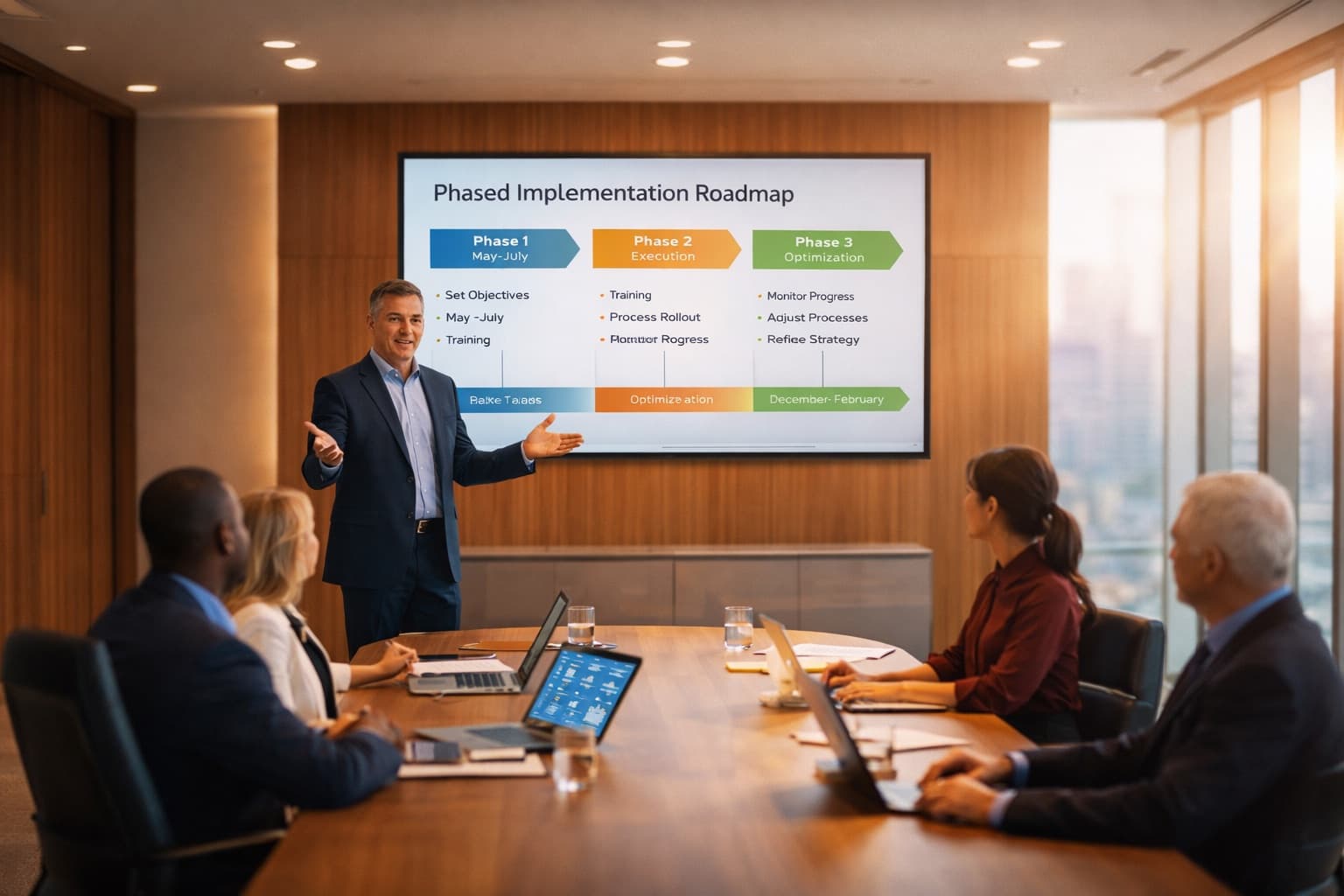
Phase 1: Proof (first 90 days). One or two MGPs focused on quick wins: variance commentary, duplicate invoice detection, or reconciliations. These establish credibility with practitioners, auditors, and leadership.
Phase 2: Copy with variation (months 4 through 6). Replicate successful MGPs across adjacent workflows. An AP duplicate detection pilot extends to purchase-order matching. Variance commentary on revenue accounts extends to expenses, then cash flow. Each new pilot reuses the prompt libraries, evaluation templates, and evidence packs from the previous one. Setup time drops. Adoption accelerates because staff already know the process.
Phase 3: Wave planning (months 6 through 24). Combine multiple MGPs into broader programs: close acceleration, forecasting modernization, decision support. Each wave advances only when the prior cycle's ROI, governance, and adoption are proven.
Every completed MGP leaves behind assets that compound. Prompt libraries become more comprehensive. Evaluation reports build benchmarks. Evidence packs demonstrate consistency. By the 12-month mark, the finance function has a managed portfolio of AI capabilities with documented ROI, and the CFO has the evidence base to justify continued investment to the board.
The board conversation changes. With a portfolio view, the discussion shifts from "does this single tool pay for itself?" to "how is our AI portfolio compounding returns and reducing execution risk over time?" That framing, matching AI investments against other capital priorities using consistent inputs and risk treatment, cements the CFO's role as the enterprise architect of AI capital allocation.
What Comes Next
Generative AI in finance is still in the "trust but verify" phase. Like working with a new analyst, we respect the capability but still need to ensure it's been applied appropriately to the task at hand.
The most productive mindset is a simple habit: routinely ask, "How can I do this with AI?" Sometimes the answer is "you shouldn't." Sometimes it's "use it for the first pass." And sometimes the answer saves the team ten hours a month and makes the output more consistent.
The building blocks are in place. Enterprise-grade LLMs meet compliance standards. Governance frameworks exist. The implementation path is documented. The CFOs who move now, with discipline and evidence, will define what AI-ready finance looks like for the rest of the industry.
Good data governance makes everything better, with or without AI. Clear definitions reduce meeting time. Clean processes reduce close pain. Better documentation reduces key-person and audit risk. A disciplined operating model makes automation easier and safer. That foundation is the starting point. Everything else builds on it.
Continue Learning
Glenn Hopper is a multi-time CFO, author of three books on AI in finance, and adjunct faculty at Duke Fuqua. He teaches AI for Corporate Finance at Section and keynotes for organizations including the AICPA, Harvard's D³ Institute, Corporate Finance Institute, and the CfO Leadership Council.
Need help putting these frameworks into practice?
G3 Consulting works with finance teams to evaluate, implement, and govern AI across the finance function. Let’s talk about where you are and where you want to go.
Get in TouchTry it yourself
Not ready for a full engagement? Our self-serve AI tools deliver consulting-grade analysis in under 15 minutes. Free tier included.
Explore tools & pricing → Ask SAL