Your Finance Team Needs an AI Governance Policy. Here's What Goes In It.
The FS-ISAC published its framework for acceptable use of generative AI in financial services last year. It runs 14 pages and covers data classification, vendor risk, and intellectual property protection. It's a solid starting point. It's also completely generic. Nothing in it addresses SOX compliance workflows, model validation requirements for financial projections, or what happens when an analyst pastes customer payment data into ChatGPT to debug a reconciliation formula. Finance teams need something more specific.
A Wolters Kluwer report from early 2026 found that financial services leaders are accelerating AI adoption while regulators simultaneously sharpen their focus on how those systems are controlled and governed. That's the tension most finance organizations are sitting in right now: the tools are capable, the team wants to use them, and nobody has written down the rules. The gap between "we should have a policy" and "we have a policy" is where risk accumulates.
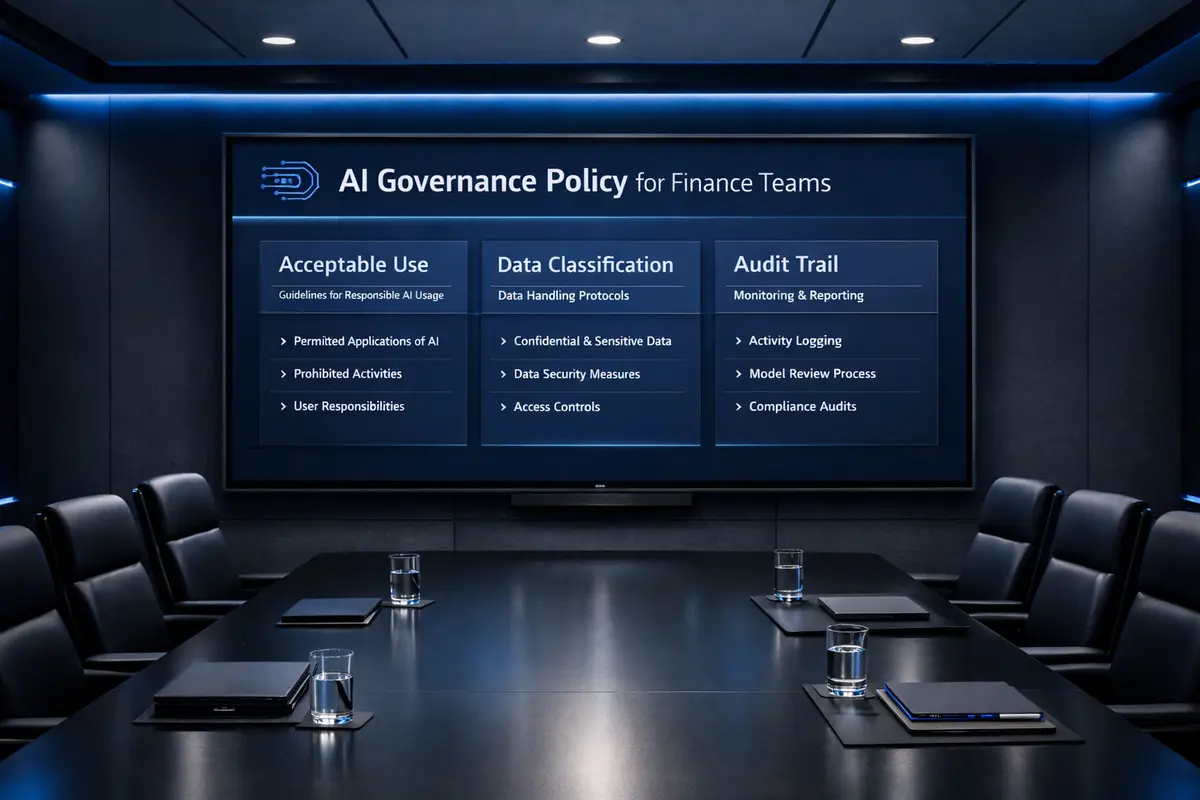
Here's what a governance policy for a finance team actually needs to cover. Start with data classification. Your team handles four distinct tiers of data sensitivity: public financial statements, internal management reports, customer payment information, and employee compensation data. Each tier needs different rules for what can interact with AI tools. A structured implementation approach helps sequence these decisions. An analyst summarizing a public earnings call transcript in Claude is fine. That same analyst pasting a customer accounts receivable aging report into the same tool is a different risk profile entirely. The policy needs to draw those lines clearly enough that someone in their first week on the job can follow them.
Acceptable use comes next, and it needs to be specific to finance workflows. Drafting variance commentary, generating forecast scenarios, summarizing vendor contracts: these are low-risk, high-value use cases that most policies should greenlight with basic guardrails. Running credit risk analysis on customer data, generating tax positions, or producing numbers that flow into external filings: these require human validation checkpoints and approved tools. The distinction isn't "AI good" or "AI bad." It's which workflows carry regulatory or audit exposure and which don't. A good policy maps every major finance process to a risk tier and specifies the review requirements for each.
Model validation is where most generic templates fall apart completely. Finance teams that use AI-generated forecasts or projections need a validation framework that mirrors what they already do for Excel models, because auditors will ask about it. That means documenting inputs, assumptions, and outputs. It means testing AI-generated projections against actuals on a defined schedule. And it means maintaining version control so you can trace which model produced which number in which reporting period. The EU AI Act classifies AI systems used in creditworthiness assessment and financial product pricing as high-risk, with full compliance required by August 2026. Even if you operate outside the EU, these standards are becoming the baseline auditors and regulators reference globally. Assessing where your team stands with an AI Readiness Scorecard can surface governance gaps before auditors do.
Escalation procedures need to answer a question that sounds simple but trips up most organizations: when an AI-generated output is wrong, who owns the error? If an agent drafts a journal entry that misstates revenue by $200K and a controller approves it, the accountability sits with the controller. The policy needs to make that explicit. It also needs to define what triggers escalation: a variance threshold, a data quality flag, a compliance exception. Vague language like "material errors should be reported" doesn't help anyone. Define the thresholds. Name the roles. Specify the timeline.
Audit trail requirements round out the policy. Every AI-assisted decision that touches the financial statements needs a log: what tool was used, what inputs it received, what output it produced, who reviewed it, and when. This isn't optional for SOX-compliant organizations. It's the same documentation standard you apply to spreadsheet models, applied to a different kind of tool. The good news is that most enterprise AI platforms generate these logs automatically. The policy just needs to specify where they're stored, how long they're retained, and who can access them.
Writing this from scratch takes weeks if you're doing it properly. Getting legal, compliance, IT, and the finance team aligned on every section adds more. If you want a shortcut that produces something real, RoboCFO's AI Governance Policy Generator walks you through a 15-minute questionnaire about your regulatory environment, team structure, and AI maturity, then generates a complete 18-30 page policy document calibrated to your answers. It covers every section outlined above, including the RACI matrix and escalation procedures that most templates skip. A law firm charges $5,000 to $15,000 for comparable work.
 Ask SAL