How to Calculate the ROI of AI in Your Finance Department. A Practical Framework.
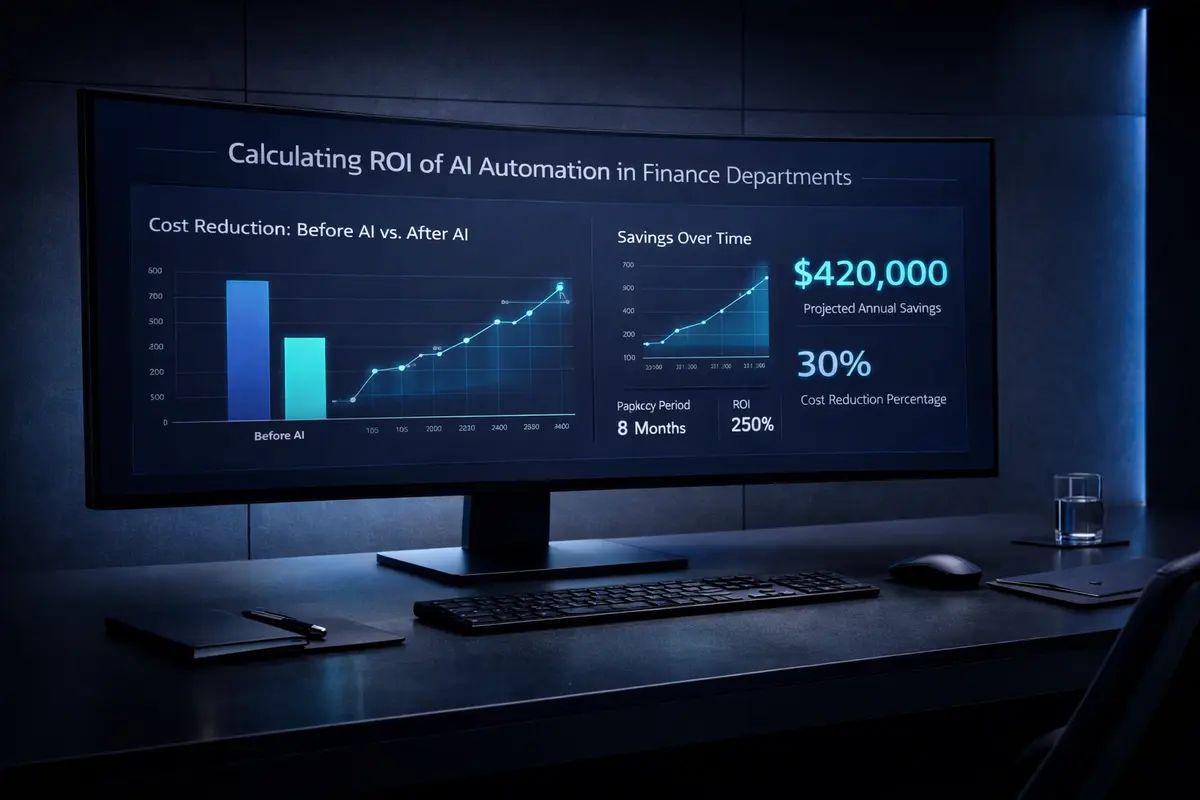
A CFO Dive survey from late 2025 surfaced a telling contradiction: 68% of finance departments reported experiencing significant ROI from their AI investments, but 71% of finance leaders said they were concerned about measuring that ROI accurately. Both numbers are probably true. Finance teams are seeing real efficiency gains from AI automation. They're just not confident they're capturing the full picture, or that the numbers they're reporting would survive scrutiny from a board member who asks hard questions.
The measurement problem starts with scope. Most ROI calculations for AI in finance focus exclusively on labor hours saved, which is the easiest metric to quantify and the least interesting one. A five-person FP&A team that spends 75% of its time on data collection and formatting represents roughly $375K to $560K in annual labor cost directed at work that doesn't require human judgment. These are exactly the high-value AI use cases for FP&A that deliver the clearest payback. Automating 70% of that data work saves $260K to $390K. Real number, easy to calculate. But it misses the second-order effects that often exceed the direct savings.
Those second-order effects are where the actual value compounds. The Dual ROI Framework captures both the tangible and strategic dimensions that a simple hours-saved calculation misses. Consider forecast accuracy. AI-assisted forecasting tools cut forecast errors by 20 to 50%, according to current industry data. A company running $200M in revenue with a 15% forecast variance is making resource allocation decisions with a $30M margin of error. Tightening that to a 5% variance means decisions are calibrated to a $10M window instead. The financial impact of better capital allocation, inventory management, and hiring decisions over a fiscal year dwarfs the $300K you saved on analyst time.
Speed creates its own return. One retail CFO reported compressing their quarterly forecast cycle from 28 days to 8 days after deploying AI-driven automation. That's 20 additional days per quarter where leadership has current financial data instead of stale projections. Over a year, those three extra strategic planning cycles drove $3M in incremental revenue through faster pricing adjustments and inventory rebalancing. That number never shows up in a simple "hours saved times hourly rate" calculation.
Accounts payable provides one of the clearest ROI cases because the inputs are so measurable. If your team processes 10,000 invoices per month and automation saves 10 minutes per invoice, that's 1,667 hours recaptured, roughly $50,000 per month at a blended rate of $30 per hour. Layer on early payment discount capture (organizations with $20M in payables capturing 2% discounts on 30% of spend save $120K annually) and fraud reduction from automated three-way matching, and a single AP automation deployment can return $200K to $400K in the first year. The payback period on most AP automation projects runs 12 to 18 months, with returns accelerating as the system learns your vendor patterns and exception rates decline.
The framework that holds up to board-level scrutiny measures three layers. Direct savings: labor hours eliminated, overtime reduced, processing costs decreased. Operational improvement: cycle time compression, error rate reduction, compliance cost avoidance. Strategic value: decision quality improvement from better data, revenue impact from faster insights, risk reduction from continuous monitoring versus periodic sampling. Weight them roughly 40-60% direct, 25-35% operational, 15-25% strategic, and you have a model that captures the full picture without stretching into speculative territory.
A caution worth noting: AI costs are front-loaded while benefits are back-loaded. Implementation, data preparation, integration work, and team training all hit in months one through six. Returns accelerate in months six through eighteen as adoption deepens and the system improves. Organizations that evaluate AI on a 12-month horizon will almost always reject it. The right evaluation window is 24 to 36 months, which is the same lens you apply to any enterprise software investment. Before committing that budget, running a quick AI Readiness Scorecard helps confirm your team is positioned to capture the returns.
If you want to model this for your own team, RoboCFO's Finance AI ROI Calculator walks you through your current operational reality, including team size, process volumes, cycle times, and error rates, and generates a quantified business case across conservative, moderate, and aggressive scenarios. The free tier gives you a high-level savings estimate. The full report adds a Dual ROI Lens covering both tangible returns and strategic value, industry-calibrated benchmarks, a phased implementation roadmap, and a board-ready executive summary you can present to your leadership team.
 Ask SAL